Debt snowball vs debt avalanche: which should you use?
Both methods pay the minimum on every debt and put every spare dollar on one target. The only difference is which debt you target first, and that choice matters less than sticking with it.
The short answer: the avalanche (highest interest rate first) always costs the least interest. The snowball (smallest balance first) gives you a paid-off debt sooner, which keeps many people going. If the gap in interest is small, pick the one you will actually keep doing.
How both methods work
- List every debt with its balance, interest rate (APR) and minimum payment.
- Decide a monthly total you can pay toward debt: all the minimums plus whatever extra you can find.
- Pay the minimum on every debt, every month, so nothing goes late.
- Put all the extra on one target debt. Snowball: the smallest balance. Avalanche: the highest interest rate.
- When the target is paid off, roll its whole payment onto the next one. The payment grows as each debt disappears, like a snowball rolling downhill. Keep your monthly total the same until everything is gone.
A worked example
Three debts, $12,400 in total, with $330 a month in minimums and $200 extra, so $530 a month:
| Debt | Balance | Interest rate | Minimum |
|---|---|---|---|
| Store card | $900 | 15% | $30 |
| Credit card | $4,500 | 24% | $120 |
| Car loan | $7,000 | 7% | $180 |
| Snowball | Avalanche | |
|---|---|---|
| Order | Store card, credit card, car loan | Credit card, store card, car loan |
| First debt paid off | Month 5 | Month 17 |
| Debt-free | Month 27 | Month 27 |
| Total interest | $1,837 | $1,735 |
Here the avalanche saves about $100, and both finish in the same month. The snowball gets its first win a full year earlier. Without the extra $200 a month, still rolling each freed payment onto the next debt, the same debts take 52 months and about $4,590 in interest. The extra money matters far more than the order.
The gap grows when a large debt has a much higher rate than a small one, for example a big card at 29% next to a small loan at 5%. Then the avalanche can save hundreds or thousands. Work out both before you choose.
Which one to choose
- Choose the avalanche if the numbers show a big difference, or if you stay motivated by watching the total interest shrink.
- Choose the snowball if you have tried before and stopped, or if you have several small debts you could clear within a few months.
- A middle way: clear one or two tiny debts first for the quick win, then switch to the avalanche.
Finding the extra money
- Cancel subscriptions you haven't used this month.
- Put windfalls on the target: tax refunds, bonuses, gifts, things you sold.
- Ask your card company for a lower rate. It is a short call, and it sometimes works.
- Keep a small emergency fund anyway, so a car repair doesn't go back on the card.
Tracking it so you keep going
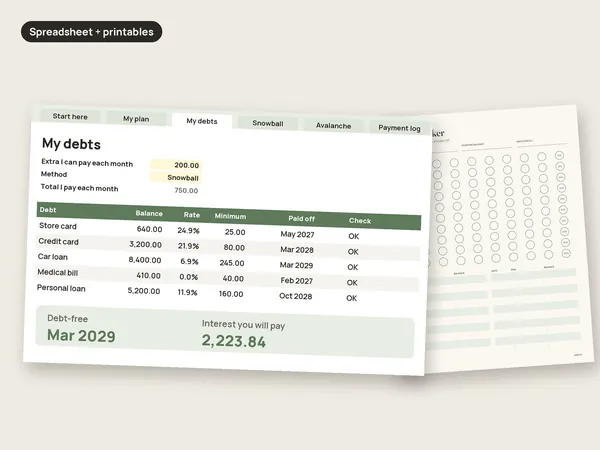
A payoff plan works when you can see it moving. Write down the debt-free date, log every payment, and colour in a tracker as balances fall. Our debt payoff tracker does the maths for you: enter up to 12 debts in Excel, Google Sheets or Numbers, and it shows your debt-free date, total interest and a snowball vs avalanche comparison side by side, plus printable colour-in trackers for the fridge.
This guide explains common methods and is not financial advice. For debt you can't keep up with, talk to a free, non-profit debt counselling service in your country.