How to start a reading journal, and actually keep it
A reading journal makes books stay with you longer. You remember the story, the line that stopped you, and the friend you wanted to give it to. It only works if it stays easy, so here is how to keep it light.
The short answer: log every book you finish with a rating, write three lines about it while it is fresh, and keep one fun tracker (a bookshelf to colour or a reading challenge) to see your year add up.
What to track
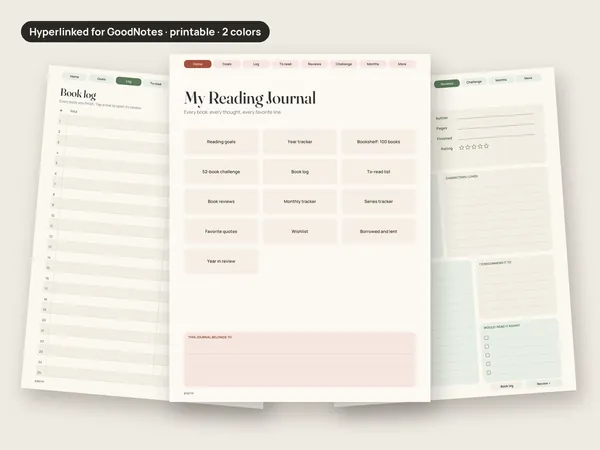
- A book log: title, author, date finished and a rating. This is the one page to keep up.
- A to-read list, so you never wonder what to read next.
- A bookshelf tracker: colour a spine for each book you finish; it is surprisingly motivating.
- A monthly page: which days you read, and your book of the month.
What to write about each book
- One line on what it was about, in your own words.
- What you liked, or didn't, and why.
- A favourite quote or moment.
- Who you would recommend it to.
Three lines are plenty. A short review written the day you finish beats a long one you never write.
Reading challenge ideas
- A book set in a country you have never visited.
- A book older than 100 years.
- A book you have owned for years but never read.
- A book a child recommended.
- A book in translation, a memoir, a book of poetry.
Digital or printable?
A digital journal on a tablet is always with you, and links make it quick: tap a book in the log and its review page opens. A printed journal suits book clubs and anyone who prefers a pen. Many readers use both: digital day to day, a printed year in review for the shelf.
Ready to use
Our reading journal has a hyperlinked book log with 50 review pages, a 52-book challenge, a 100-book bookshelf to colour, monthly trackers and more, for GoodNotes and other apps, plus printable pages in US Letter and A4.